

Hut, hut!
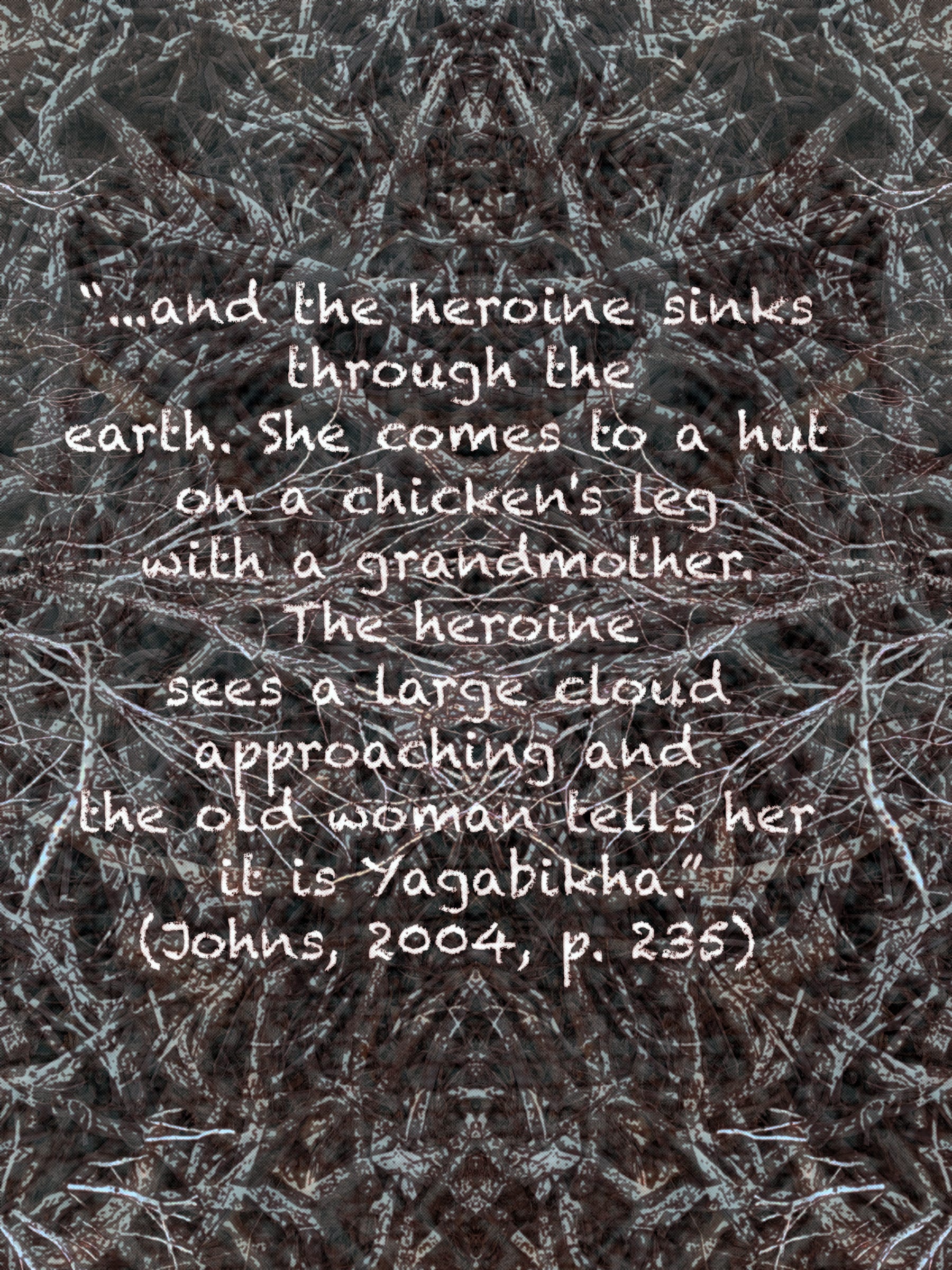
Visiting Baba Yaga

…she lives in the forest, in a hut which stands or turns around on chicken or hen's legs (izbushka na kur’ikh nozhkakh), or goat legs and ram horns (na koz'ikh nozhkakh, na baran'ikh rozhkakh, in Zelenin Perm' 6) or a spindle heel (na veretennoi piatke). Visitors to her hut use a traditional phrase to make the hut turn around and face them: "Hut, hut! Stand with your back to the forest, your front to me" (Izbushka, izbushka! Stan' k lesu zadom, a ko mne peredom). (Johns, 2004, p. 2)
Hut, hut! Stand with your back to the forest, your front to me!
This is the call from the modernist visitor, over the hedge, to Baba Yaga’s hut. The visitor thinks he can control mystery with his codified language. But the hut will only turn if she wants to—it is an illusion that Baba Yaga and her domain can be commanded.
Baba Yaga’s realm is the old sacred forest. Anyone who visits from the developing village, visits from a place where Baba Yaga is progressively desecrated.
The space between the villager and Baba Yaga is the hedge. The modernist visitor from the “developing” village is logos. The visitor who seeks her power for his individual gain wants everything to turn to face him. This villager does not want to go into the forest, so he commands the hut to turn. The hut is speculative. The hut is real in the way that things beyond perception are real. The hedge could be called the entanglement that can’t be bought or sold.
Baba Yaga never goes looking for someone to persuade. She reads the intents of those who come to her through impossible tasks—tasks that are only impossible for those without humility. She initiates some and sends others astray, chasing the golden tail of their own desire.
The girls fleeing patriarchal imbalance follow her matri-liminal texts. They listen to the knowings of plants and animals. They receive the gift of the incinerating gaze from the skull lantern. They subsume in the magic of wonder with which they subsume realist ontology, “Wonder inhabits thresholds—between unknowing and knowing, thinking and feeling (Lugli, 1986). It destabilizes the opposition between subject and object, inside and outside, by seeming to inhabit both. It short-circuits the mechanisms of choice and the exercise of will, since to experience wonder feels both like choosing and being chosen” (MacLure, 2024, p. 1651).
I imagine that I am a girl villager, and the patriarchy has sent me to fetch fire for the empty hearth.
I am a girl villager who ducks under the brambles. I get caught in the thorns and I eat a handful of blackberries. I kiss the plants that scrape and feed me. I speak through the hedge asking the hut to stay facing the forest of things “always differentiating and coming into being together” (St. Pierre, 2024, p.1601).
Prompt:
Visit Baba Yaga. What is the three-step impossible task? What wonder is offered within the impossible task that remakes the world otherwise?

References
Johns, A. (2004). Baba Yaga: The ambiguous mother and witch of the Russian folktale. P. Lang.
MacLure, M. (2024). “Something comes through or it doesn’t”: Intensive reading in post-qualitative inquiry. International Journal of Qualitative Studies in Education, 37(6), 1647–1654. https://doi.org/10.1080/09518398.2024.2342696
St.Pierre, E. A. (2024). Reading for post qualitative inquiry. International Journal of Qualitative Studies in Education, 37(6), 1600–1610. https://doi.org/10.1080/09518398.2024.2340041
This is such a deeply nourishing and exciting post and conversation in general. I'm so inspired!
I'm beyond grateful to learn from your work, Kim!